


Summer 2025 Fieldwork in Coastal Peru
Expedition Location: Peru (Lima, Nuevo Chimbote, Chao, Huanchaco, Trujillo, Chiclayo)
Expedition Dates: July 7th – July 25th
Field Team Members: Kate Johnson, Emily Blackwood, Dr. Daniel Sandweiss, Dr. Alice
Kelley, Dr. Shaleen Jain, and Dr. Allen Gontz
Funding Support: Sturgis Exploration Fund (SEF)
Introduction:
My thesis, titled “Calibrating Isotopic Analysis of Mollusk Shell Material as a Proxy for ENSO Behavior in North Coastal Peru”, is one of many University of Maine projects currently underway in the coastal region of Peru. In Peru, our group traveled up the coast from Lima to Chiclayo over the course of about two weeks. During this trip, we stopped at several archaeological sites for educational purposes, including the Huacas de Moche and El Brujo, as well as several research sites, such as the Ostra Site and Playa El Dorado. Below, I provide a brief summary of my research project to situate the fieldwork results and significance described in the next section.
ENSO (El Niño Southern Oscillation) is a major, large-scale climate event that significantly stresses populations of plants, animals, and humans around the Pacific. Along the coast of Peru, during most years, upwelling driven by the Humboldt Current brings cold, nutrient-rich bottom water to the surface, promoting primary productivity and ecosystem biodiversity (Sandweiss et al. 2020). Every 2 to 7 years, ENSO events reverse these upwelling trends, reducing nutrient availability and raising sea surface temperatures (SST) along the coast (Andrus et al. 2008). As ENSO significantly impacts coastal Peru, having reliable methods to track these events is essential. Sandweiss et al. (2020) note that many climate proxies (e.g. speleothems, snow and ice cores, and corals) that are ubiquitous in other regions are rather uncommon in arid, desert regions of Peru, making it difficult to reconstruct paleoclimates; as a result, they assert that the archaeological record offers one of the most useful sources of paleoclimate proxy data (Sandweiss et al. 2020).
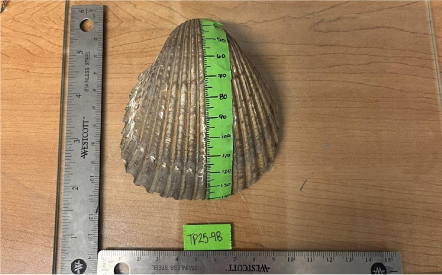
One of these archaeological proxy sources is mollusk shells. Existing literature demonstrates how stable isotopes and trace elements taken up during shell deposition by mollusks that survive El Niño events can be proxies for upwelling and sea surface temperature (SST) anomalies, two environmental conditions affected by ENSO behavior (Andrus et al. 2005, Carre et al. 2005, Pérez-Huerta et al. 2013, Rollins et al. 1987, Sadler et al. 2012). While most mollusk species die off during ENSO events due to unfavorable environmental conditions, some less sensitive species, such as Trachycardium procerum (Figure 1), exhibit resilience to El Niño and continue to deposit shell material once or twice daily over their one to three-year lifespan (Pérez-Huerta et al. 2013, Sandweiss et al. 2001). My research analyzes carbon and oxygen isotopes from T. procerum samples collected from coastal Peru. To calibrate this comparison, I will identify isotopic trends from shell records that correlate with specific ENSO variations.

Results and significance:
My fieldwork this summer was divided into two phases. During the first phase, I traveled to Peru to collect my Trachycardium procerum shell specimens. This collection occurred at Playa El Dorado, a fishing site in Nuevo Chimbote, Peru (Figure 2). As I lack the proper scuba certifications, we hired a local fisherman, John Flores, to help us collect T. procerum mollusks offshore at a depth of about 8.5 meters. On the boat, I bagged 10 live mollusks (Figure 3). Then, back in my hotel room, I shucked each mollusk and set the shells out to dry. During the second phase, I traveled to the Stable Isotope Paleo Environments Research Group (SIPERG) lab at Iowa State University to collect isotope samples. With the help of Dr. Alan Wanamaker, I sampled the total length of four shell halves, two modern shells collected in July 2025 and two mid-Holocene shells from the existing collection, for a total of 540 samples (Figure 4). Finally, after all four shells had been sampled, I left the samples with the lab manager, Suzanne Ankerstjerne, for δ13C and δ18O analysis on the mass spectrometer.

I chose to analyse δ13C and δ18O isotopes in my shell samples because of their correlation with upwelling and sea surface temperature, respectively (Andrus et al. 2008, Killingley and Berger 1979). My hypothesis regarding these isotope values is as follows: Trachycardium procerum mollusks take up water isotopes during growth, and due to the correlation between these carbon isotopes and upwelling and oxygen isotopes and SST, two points of variability across ENSO phases, isotope data from T. procerum should correlate with ENSO records. To test this hypothesis, I will first conduct reverse age modeling and growth rate analysis on the two modern shells to determine the exact age of each and account for growth rate changes across their lifespan. This will give the millimeter increment samples a more accurate temporal dimension. I will also compare mollusk δ13C and δ18O values with ENSO records, such as the ONI (Oceanic Niño Index), to identify diagnostic mollusk isotope values for distinct ENSO phases. Finally, I will compare the two mid-Holocene shells to the modern shells, looking for any diagnostic isotope values.
The major implication of this thesis project for future research is the calibration of mollusk proxies for ENSO behavior in Peru. If I can prove that modern mollusk δ13C and δ18O isotope values reliably correlate with known ENSO-related changes in upwelling and sea surface temperature, this method can be applied to shells with unknown ENSO conditions, such as ones from archaeological sites.
Acknowledgements:
I would first like to thank the Robert and Judith Sturgis Family Foundation Exploration Fund for providing financial assistance for this trip. I would also like to thank John Flores and his fishing boat, “Daniel”, for collecting Trachycardium procerum shells from Playa El Dorado. Lastly, I would like to thank Dr. Alan Wanamaker and Suzanne Ankerstjerne, of the Stable Isotope Paleo Environments Research Group (SIPERG) at Iowa State University, for providing lab space, training on shell isotope sampling, and mass spectrometer data.
References:
Andrus, C. Fred T., Daniel H. Sandweiss, and Elizabeth J. Reitz. 2008. “Climate Change and Archaeology: The Holocene History Of El Niño On The Coast Of Peru.” In Case Studies in Environmental Archaeology, edited by Elizabeth J. Reitz, Sylvia J. Scudder, and C. Margaret Scarry, 143–57. New York, NY: Springer. https://doi.org/10.1007/978-0-387-71303-8_8.
Carré, Matthieu, Julian P. Sachs, Sara Purca, Andrew J. Schauer, Pascale Braconnot, Rommel Angeles Falcón, Michèle Julien, and Danièle Lavallée. 2014. “Holocene History of ENSO Variance and Asymmetry in the Eastern Tropical Pacific.” Science, August. https://doi.org/10.1126/science.1252220.
Killingley, J. S., & Berger, W. H. (1979). Stable Isotopes in a Mollusk Shell: Detection of Upwelling Events. Science, 205(4402), 186–188. https://doi.org/10.1126/science.205.4402.186
Pérez-Huerta, Alberto, Miguel F. Etayo-Cadavid, C. Fred T. Andrus, Teresa E. Jeffries, Clifton Watkins, Shane C. Street, and Daniel H. Sandweiss. 2013. “El Niño Impact on Mollusk Biomineralization-Implications for Trace Element Proxy Reconstructions and the Paleo-Archeological Record.” PloS One 8 (2): e54274. https://doi.org/10.1371/journal.pone.0054274.
Rollins, Harold B., Daniel H. Sandweiss, Uwe Brand, and Judith C. Rollins. 1987. “Growth Increment and Stable Isotope Analysis of Marine Bivalves: Implications for the Geoarchaeological Record of El Niño.” Geoarchaeology 2 (3): 181–97. https://doi.org/10.1002/gea.3340020301.
Sandweiss, Daniel H., C. Fred T. Andrus, Alice R. Kelley, Kirk A. Maasch, Elizabeth J. Reitz, and Paul B. Roscoe. 2020. “Archaeological Climate Proxies and the Complexities of Reconstructing Holocene El Niño in Coastal Peru.” Proceedings of the National Academy of Sciences 117 (15): 8271–79. https://doi.org/10.1073/pnas.1912242117.
Sandweiss, Daniel H., Kirk A. Maasch, Richard L. Burger, et al. 2001. “Variation in Holocene El Niño Frequencies: Climate Records and Cultural Consequences in Ancient Peru.” Geology 29(7): 603–606.
World Bank (n.d.). Peru—ENSO (ERA5) | Climate Change Knowledge Portal. Retrieved November 11, 2025, from https://climateknowledgeportal.worldbank.org/country/peru/enso