

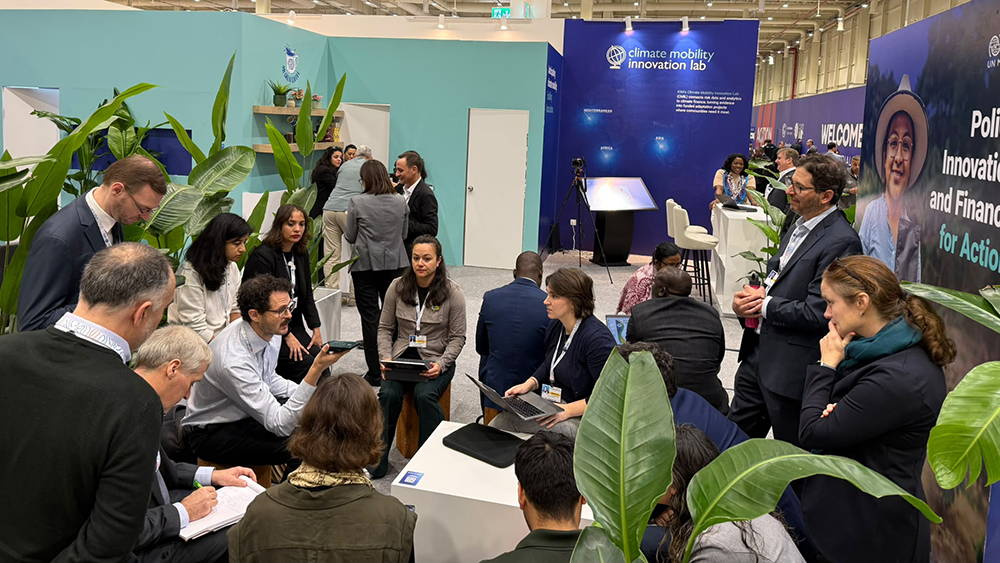
Climate Mobility at COP 31 [or] Where will humans live after climate change – and how will we get there?
Alice Farmer, Associate Professor of Law, University of Maine School of Law
It’s been really thrilling to follow the climate mobility discussions at COP this year. Climate mobility is an urgent question: as the world around us changes, where will humans live? During the Ceremonial Opening, the President of Negotiations, Australia’s climate and energy minister, referred to “glacial collapse in Nepal [and] heat deaths in Europe” as some of the factors impacting where people can live. Indeed, hundreds of millions of people live in areas likely to be highly affected by climate change, including much of the population of the United States. Some people will move to more hospitable ground, some will be able to adapt in place, and some of us will simply be stuck, increasingly battered by storms, wildfires, and droughts.
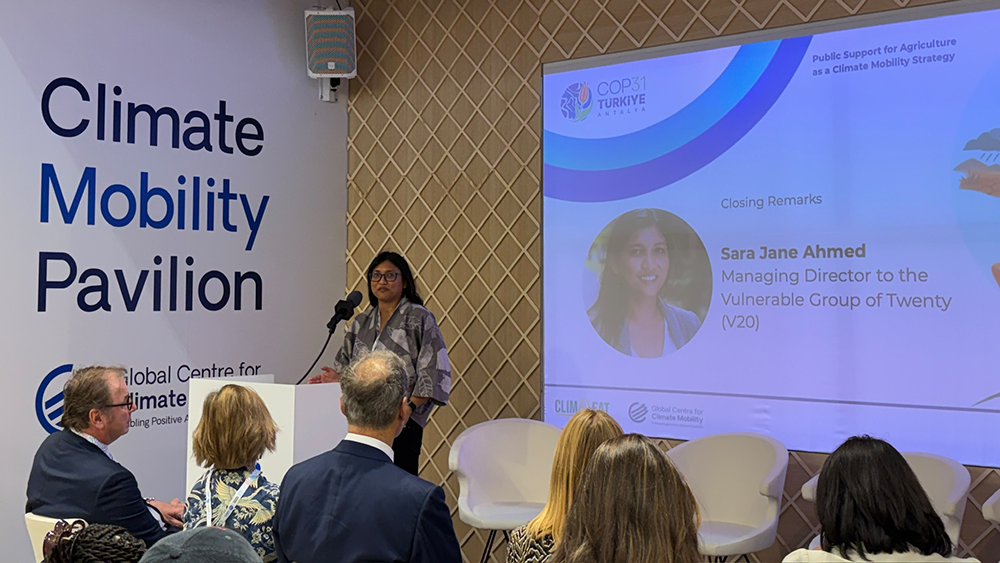
At COP, I’m part of the Advisory Group on Climate Change and Human Mobility. Within the Advisory Group, we’re following the issue in the “adaptation” streams of the diplomatic negotiations. Migration is a key strategy for adapting to climate change – and, as I’ve commented elsewhere, there need to be policies and resources to support people in this transition.
At successive COPs, countries have formed coalitions to increase power in their calls for solutions to climate displacement. For instance, the Alliance of Small Island States (AOSIS) advocates around rising sea levels in the Pacific, the Caribbean, and elsewhere – and how it impacts people’s abilities to fish, farm, and live. This year, AOSIS continues to prioritize the “right to stay” in negotiations, seeing cross-border migration as a last resort. But acknowledging that some movement is inevitable, they call for dignified and rights-based pathways that respect national sovereignty.
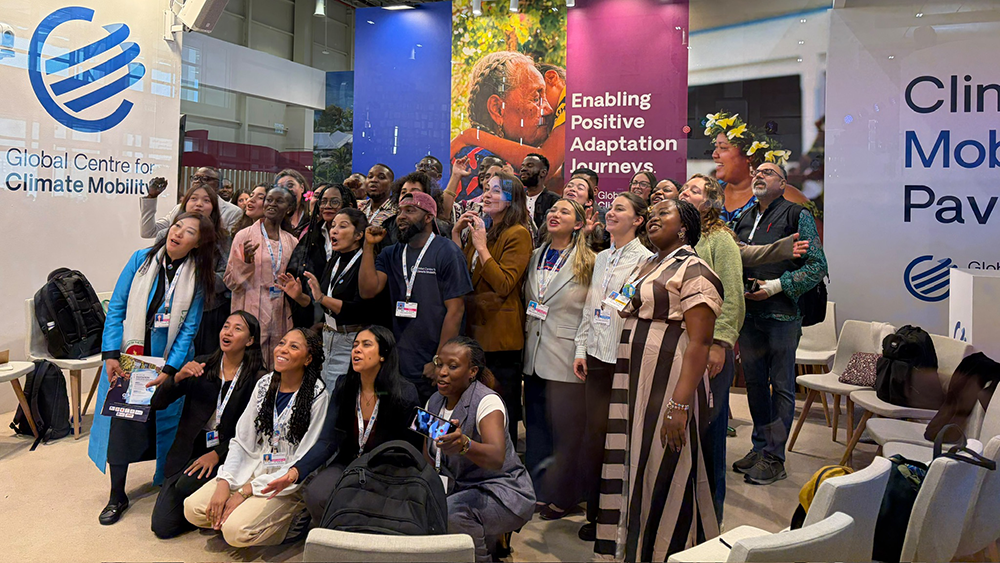
Some governments and NGO advocates are pushing for climate displacement policies to be developed in consultation with people who are most directly affected. The Beyond Climate Collaborative has been profiling youth voices: young leaders from places as far apart as Bangladesh, Ecuador, and Kenya came to COP to speak about new grassroots solutions to climate mobility issues. They want a world where people have the autonomy and self-determination to make choices about where and how to migrate. They want to shape the future of their communities – and they’re calling for resources and support to do that.
In formal negotiation channels, we are starting to see progress along these lines. Diplomats met on Tuesday to continue negotiations on the Global Goal for Adaptation – part of the Paris Agreement that seeks to enhance adaptive capacity and reduce vulnerability to climate change. Parties widely agreed that adaptation funding was necessary, with Brazil calling for recognition of the contributions of migrants to adaptation. Some lower income countries expressed “strong disappointment” that tripling adaptation finance did not become an agenda item, emphasizing that implementation is not possible without closing the finance gap.
Likewise, Tuesday’s negotiations on the Fund for Responding to Loss and Damage (FRLD) included references to climate displacement, with, for example, the Somali delegate mentioning droughts and floods that are forcing communities to move. Many countries, including Philippines, emphasized the need for modalities that enable small communities to access money from the FRLD, with hopes that rapid disbursement can avert and minimize displacement.
This notion of community-driven change resonates throughout the climate mobility discussions, with the Ghana delegate in the FRLD negotiations pointing out that communities along the Ghana coast continuously have to move to look for safer places. Meanwhile, a directly-affected Solomon Islander speaking at an NGO event encapsulated a way forward by saying, “More people from rural communities should be part of the conversations. The people on the frontlines who are losing their homes, losing their culture, losing their livelihoods – it’s important for change to reach them from up here, not to stop in the middle.”