


Digital Data Capture from the Ostra Collecting Site, Peru
Expedition Location: Peru
Expedition Dates: July 7th – 24th, 2025
Field Team Members: UMaine: Emily Blackwood (Ph.D. candidate), Katelyn Johnson (MS student), Dan Sandweiss* (Professor), Alice Kelley (Associate Research Professor), Shaleen Jain (Professor); Clarkson University: Alan Gontz (Professor); Ramiro Acosta (Peru).
Funding Support: Sturgis Exploration Grant
Introduction:
For several weeks in July of 2025, I traveled to Peru as part of an interdisciplinary team of researchers. My role and objectives were to capture new and extend previously created 3D models of structures, spaces, and cultural materials at an archaeological site on the north coast of Peru radiocarbon dated to the mid-Holocene. Previous research at this site has revealed a collection of environmental and cultural components that are unique to this specific space and time. As part of my dissertation research, I am digitally reconstructing this site in virtual reality, allowing me to examine these unique components from a more holistic perspective and foster collaboration across disciplines.
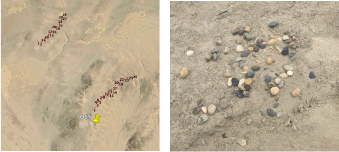
To briefly set the stage, the site (Ostra Collecting Station or OCS) is radiocarbon dated to ~6,000-6,600 calendar years before present (B.P.) and was located within a space that was naturally protected / defended from the west (Pacific Ocean), the east (Andean foothills), and positioned on the top of an ancient sea-cliff at the base of the foothills. In this space are the ruins of a 9 x 8 m granite stone structure (considered large for that time/area) as well as ~30 piles of slingstones that extend outward from the structure in a line to the east with another line of ~30 piles located ~200 meters north of the structure (Figure 1). This site is categorized as a shell heap plus the monumental granite building. The major constituent of the deposits at OCS are bivalve mollusk species that cannot currently inhabit this region of the coast primarily due to ocean temperatures being too cold (Rollins et al. 1986). Several types of cultural materials have been recovered from this site that are consistent with cultural materials recovered from coastal sites of the same age, but two stand out as entirely unique: incised pebbles and pearls. The incised (sometimes also planned) pebbles have not been recovered from any other site in Peru from any time period except the contemporary, nearby Ostra Base Camp, which makes them incredibly valuable culturally and academically. Creating 3D models of these pebbles allows us to examine their digital twins and share them with colleagues.
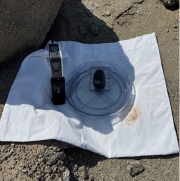
Results: A drone was flown over the site to create a digital elevation model (DEM) that will serve as the base layer of the virtual reality reconstruction. The DEM also allows us to make measurements to ascertain line of sight and angle of incidence surrounding the site to test our hypothesis of the slingstone piles being used to defend the site from northern advances (Figure 2). On this expedition and in 2024, an RTK was used to capture topographic changes as well as to tag specific locations of cultural materials with GPS coordinates. This allows us to compare the spatial distribution of the incised pebbles from previous seasons with the ones identified this season. These data are in the process of being analyzed. 3D models were captured in the field using an IPhone15, the Polycam App, a turntable, a lighting rig, and a white sheet (Figure 3). These models are accurate in size, color, shape and texture, and can be directly imported into my virtual reconstruction as well as 3D printed.
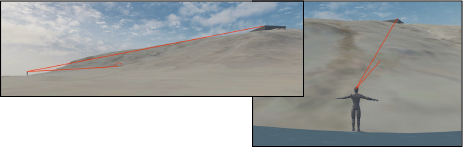
from the base of the ancient sea cliff looking up towards
the 9 x 8 m structure.
Significance: The Ostra sites represent a unique find for mid-Holocene: they represent a time of radically different climate associated with a largely maritime subsistence system, early monumental architecture, a connection to coastal Ecuador with which the Ostra sites shared environmental features (Sandweiss 1996), and possibly the earliest evidence of warfare in the Americas (Topic 1989; ongoing research by this team). This took place prior to the advent of irrigation agriculture, when horticulture (not evidenced at the sites) was just beginning. 3D virtual reconstruction of OCS and key activities there is helping understand how the inhabitants understood and used their environment.
Acknowledgements: I would like to thank the ancestors of the site used in this research for the opportunity to collect new data and add to our understanding of the context of these culturally rich spaces. A big thank you to our Peruvian collaborators, Cecilia Mauricio (Pontificia Universidad Católica del Perú) and Ramiro Acosta for their time, equipment, and knowledge! A special shoutout to Kate Johnson who helped with everything asked of her and thanks to my committee members for their help and support. Finally, a HUGE thank you to the Judith and Robert Sturgis Family Foundation Exploration Fund for providing the funding for this season of research and to Betty and Dan Churchill for funding previous seasons of research!
References:
Rollins, H.B., J.B. Richardson III and D.H. Sandweiss (1986), The Birth of El Niño: Geoarchaeological Evidence and Implications. Geoarchaeology 1:3-15.
Sandweiss, D.H. (1996), Mid-Holocene Cultural Interaction on the North Coast of Peru and Ecuador. Latin American Antiquity 7:41-50.
Topic, J. (1989), The Ostra Site: The Earliest Fortified Site in the New World? In Cultures in Conflict: Current Archaeological Perspectives, pp. 215-22.